This post describes the RPI-APP-FRAMEWORK, a python framework designed to simplify the python coding needed for your Raspberry Pi (RPI) application.
Description
rpi-app-framework is a lightweight, cross-platform Python/MicroPython library designed for building modular applications on all Raspberry Pi models. It provides a clean, reusable structure for hardware interaction, logging, and application lifecycle management. This makes it ideal for IoT, robotics, and embedded projects. The framework supports GPIO control, WiFi connectivity, motor drivers, and web servers with minimal code overhead and consistent behavior across platforms.
Base Classes
The diagram below provides a quick visual overview of how the application and device layers interact within the framework. On the left, the RPIApp base class defines the lifecycle and logging behavior for any app built on the system, while LEDLifecycleDemo demonstrates a minimal implementation. On the right, the DeviceManager base class abstracts hardware control, with LEDSimple serving as an example and a placeholder for other device managers that handle different components. Together, they illustrate the clean separation between application logic and hardware management that makes the framework scalable and maintainable.
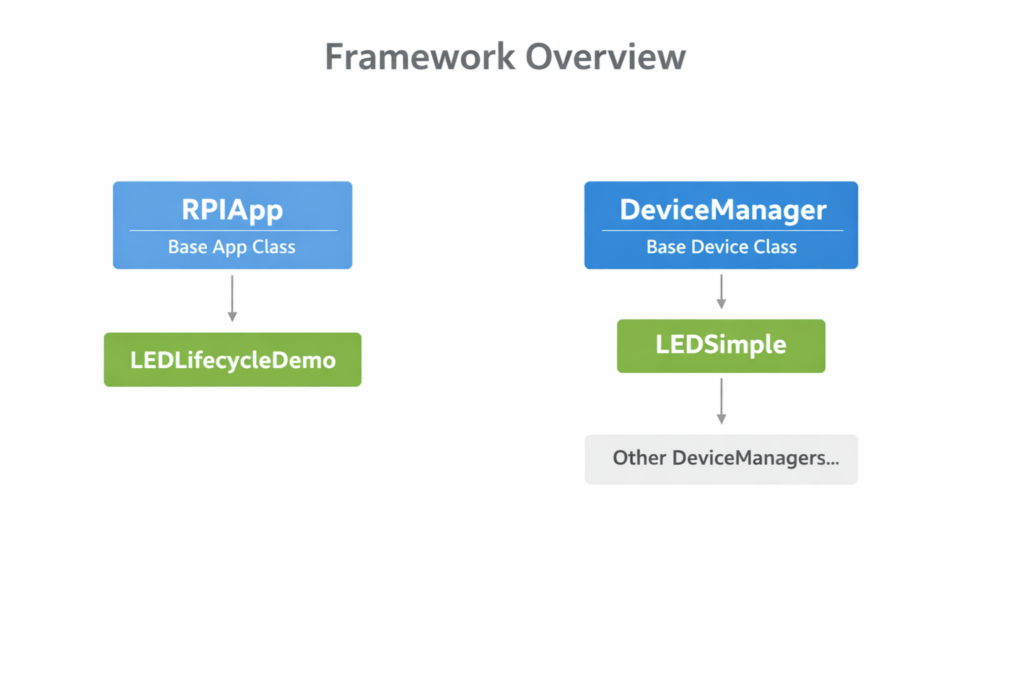
Framework Overview: This diagram shows how the LEDLIfecycleDemo app fits into the overall architecture — the RPIApp base class drives application logic, while DeviceManager handles hardware abstraction. The LEDLifecycleDemo and LEDSimple classes illustrate how app and device layers interact. There are many other device manager classes in the framework.
RPIApp
RPIApp serves as the main application class, handling startup/shutdown, automatic file logging. A developer creates an application by subclassing RPIApp, implementing setup() to initialize hardware managers (e.g., LED, motor, WiFi) and run() for the main loop, then starts it with app.start(). The framework automatically handles logging, lifecycle management, and cross-platform compatibility across Raspberry Pi models.
DeviceManager
DeviceManager is the foundation for all hardware components, offering named instances, optional logging, and a unified interface for managing devices. A developer creates a new hardware manager by subclassing DeviceManager, implementing the required control methods (e.g., on(), off(), set_speed()) depending on the functionality of the device or sensor. The custom manager can then be instantiated in setup() and used seamlessly alongside built-in components like LEDSimple or MotorDriverTB6612FNG.
Advantages
The framework’s key advantages include cross-platform compatibility via conditional imports (no code changes needed between Pico and full RPi), modular design that promotes code reuse and clean separation of concerns, robust logging with automatic file management and error tracing, and hardware abstraction that simplifies complex operations (e.g., motor speed ramping, WiFi scanning). Whether you’re blinking an LED or controlling a robot, rpi-app-framework reduces boilerplate, improves reliability, and accelerates development on any Raspberry Pi.
Future
The framework will continue to grow as it gets used in more projects. DeviceManager will be used to define additional devices such as data sensors or motor controllers. RPIApp will grow to support more generic functionality that would be useful in any RPI app. If you have any ideas for adding to the RPI-APP-FRAMEWORK please leave a comment below.